
Showing posts with label Spielberg. Show all posts
Showing posts with label Spielberg. Show all posts
Monday, May 4, 2026
Munich (2005)
The current conflict in Iran which nobody but Trump wanted has prompted me to take a look at what is probably Steven Spielberg's most controversial film.
 This film centers on the massacre of Israeli athletes by a Palastinian militia at the 1972 Olympics in West Germany, which left all the hostages and the perpetrators dead. This leads the Israeli government to send groups throughout Europe to terminate Palestinians who had a hand in planning the horrific siege. From that point on, the movie centers on a fictitious quintet of these troops, led by Avner Kaufman (Eric Bana). But the moral ramifications of doing his duty soon begins to catch up with Avner, who just became a father shortly before the Munich massacre. As a result, he begins to wonder if he is any better than the people he is being ordered to terminate and, slowly but surely, the other four men on his team-Steve (Daniel Craig), Carl (Ciaran Hinds), Robert (Matheiu Kassovitz) and Hans (Hans Zischler)-begin to feel the same way.
Munich became controversial mainly because it attempts to humanize both sides of this conflict. After all, the Nazis in Spielberg's Raiders of the Lost Ark and Indiana Jones and the Last Crusade aren't exactly portrayed as complex.
But this is why I applaud Spielberg for making a film such as this, to illustrate how reality cannot always be defined as 'good guys' or 'bad guys.' The film's conclusion is also appropriately ambiguous, especially given how events in the Middle East have unfolded in the decades since the 1972 massacre.
This film centers on the massacre of Israeli athletes by a Palastinian militia at the 1972 Olympics in West Germany, which left all the hostages and the perpetrators dead. This leads the Israeli government to send groups throughout Europe to terminate Palestinians who had a hand in planning the horrific siege. From that point on, the movie centers on a fictitious quintet of these troops, led by Avner Kaufman (Eric Bana). But the moral ramifications of doing his duty soon begins to catch up with Avner, who just became a father shortly before the Munich massacre. As a result, he begins to wonder if he is any better than the people he is being ordered to terminate and, slowly but surely, the other four men on his team-Steve (Daniel Craig), Carl (Ciaran Hinds), Robert (Matheiu Kassovitz) and Hans (Hans Zischler)-begin to feel the same way.
Munich became controversial mainly because it attempts to humanize both sides of this conflict. After all, the Nazis in Spielberg's Raiders of the Lost Ark and Indiana Jones and the Last Crusade aren't exactly portrayed as complex.
But this is why I applaud Spielberg for making a film such as this, to illustrate how reality cannot always be defined as 'good guys' or 'bad guys.' The film's conclusion is also appropriately ambiguous, especially given how events in the Middle East have unfolded in the decades since the 1972 massacre.


Thursday, March 27, 2025
Double Feature Time: Topaz/Bridge of Spies
Here are 2 Cold War thrillers that I always thought could be a double feature.

 Both Alfred Hitchcock & Steven Spielberg are certainly 2 of the most commercially successful directors ever! This is one reason I thought Hitchcock's Topaz, released in 1969, and Spielberg's Bridge of Spies, released in 2015, could be an interesting double feature.
Hitchcock's film centers on a French agent (Frederick Stafford) who becomes entangled in a Soviet spy ring just before the Cuban Missile Crisis. Spielberg's film focuses on an American attorney (Tom Hanks) who succeeds in avoiding the death penalty for the accused Soviet spy (Mark Rylance) he's defending, just before being sent to East Germany to negotiate for the release of Francis Gary Powers (Austin Stowell) who was shot down while flying over the U.S.S.R. in 1960.
Of the two films, Spielberg's has a tighter pace (Rylance deservedly won an Oscar for his performance), while Hitchcock's actually slows down in its final act. In fairness, studio heads were unsatisfied with certain aspects of Topaz, which led to Hitchcock filming an alternate ending.
Topaz, like Hitchcock's previous film Torn Curtain (1966), may have also suffered from comparison to the James Bond series, which was in full swing by 1969 (Topaz was released the same year as the 6th Bond film On Her Majesty's Secret Service).
Both Alfred Hitchcock & Steven Spielberg are certainly 2 of the most commercially successful directors ever! This is one reason I thought Hitchcock's Topaz, released in 1969, and Spielberg's Bridge of Spies, released in 2015, could be an interesting double feature.
Hitchcock's film centers on a French agent (Frederick Stafford) who becomes entangled in a Soviet spy ring just before the Cuban Missile Crisis. Spielberg's film focuses on an American attorney (Tom Hanks) who succeeds in avoiding the death penalty for the accused Soviet spy (Mark Rylance) he's defending, just before being sent to East Germany to negotiate for the release of Francis Gary Powers (Austin Stowell) who was shot down while flying over the U.S.S.R. in 1960.
Of the two films, Spielberg's has a tighter pace (Rylance deservedly won an Oscar for his performance), while Hitchcock's actually slows down in its final act. In fairness, studio heads were unsatisfied with certain aspects of Topaz, which led to Hitchcock filming an alternate ending.
Topaz, like Hitchcock's previous film Torn Curtain (1966), may have also suffered from comparison to the James Bond series, which was in full swing by 1969 (Topaz was released the same year as the 6th Bond film On Her Majesty's Secret Service).


Monday, December 16, 2024
Double Feature Time: Gremlins/Silent Night Deadly Night
Here's another article idea I had for the much-missed Agony Booth! As this is the holiday season, I thought it would be appropriate to look at 2 films from 1984 which take place during Christmas-& both of which became quite controversial.

 Gremlins took people a bit off guard upon its inital release. This may have been because Steven Spielberg's name was above the title, even though Joe Dante is the one who directed it. Indeed, Gizmo, like E.T., is a sweet little guy & the ending scene where he and Billy bid farewell may lead some to shed tear or two. But the title creatures made this much scarier than people were expecting. The subsequent criticism of the film for this, along with that of Spielberg's own Indiana Jones and the Temple of Doom which was released weeks earlier, led to the creation of the PG-13 rating. The good news is that Gremlins itself, like Temple of Doom, is wonderfully entertaining and became a deserved success.
Ironically, Silent Night Deadly Night faced criticism even though everyone knew it was going to be a slasher film. This criticism came because some genius thought it would be a good idea to run a TV spot for the film during prime time, when children were still up and about. Not surprisingly, children were upset upon seeing a commercial with Santa killing people and parents were quick to make sure that the movie was all but put in the proverbial trash bin. But the film itself doesn't do any damage to the holiday season. Indeed, I can say that, like the Friday the 13th films, it's dumb fun if you are ever in the mood for that sort of thing. Despite this controversy, the film, like Gremlins, was successful enough to spawn sequels, with Gremlins 2: The New Batch (1990) arguably being even more enjoyable than it's predecessor.
Gremlins took people a bit off guard upon its inital release. This may have been because Steven Spielberg's name was above the title, even though Joe Dante is the one who directed it. Indeed, Gizmo, like E.T., is a sweet little guy & the ending scene where he and Billy bid farewell may lead some to shed tear or two. But the title creatures made this much scarier than people were expecting. The subsequent criticism of the film for this, along with that of Spielberg's own Indiana Jones and the Temple of Doom which was released weeks earlier, led to the creation of the PG-13 rating. The good news is that Gremlins itself, like Temple of Doom, is wonderfully entertaining and became a deserved success.
Ironically, Silent Night Deadly Night faced criticism even though everyone knew it was going to be a slasher film. This criticism came because some genius thought it would be a good idea to run a TV spot for the film during prime time, when children were still up and about. Not surprisingly, children were upset upon seeing a commercial with Santa killing people and parents were quick to make sure that the movie was all but put in the proverbial trash bin. But the film itself doesn't do any damage to the holiday season. Indeed, I can say that, like the Friday the 13th films, it's dumb fun if you are ever in the mood for that sort of thing. Despite this controversy, the film, like Gremlins, was successful enough to spawn sequels, with Gremlins 2: The New Batch (1990) arguably being even more enjoyable than it's predecessor.


Monday, March 13, 2023
Saving Private Ryan (1998)
The recent passing of great character actor Tom Sizemore prompted me to look at one of his best performances, which happens to be in one of Steven Spielberg's best films.
 There really isn't much to say about this film that you probably haven't already read or heard elsewhere. Like Stanley Kubrick's Full Metal Jacket 12 years earlier, Private Ryan has a horrific but brilliantly crafted opening act that could concievably work as a short film. In this case, following a man in the present day breaking down as he visits a graveyard where numerous veterans are buried, it's a recreation of the invasion of Normandy in June 1944, also known as D-Day. Many consider this invasion the beginning of the end for Hitler's Third Reich.
In the midst of this carnage is the group of soldiers that serve as our protagonists. They are led by Capt. John Miller (Tom Hanks), whose eyes become the eyes of the audience as this nearly half hour sequence plays out eventually resulting in Miller and his men successfully taking the hill the field they are engaged in. This sequence is all the more overwhelming when you realize that this is simply a small glimpse into how extensive this battle was, as it stetched across the entire northern French coast.
There really isn't much to say about this film that you probably haven't already read or heard elsewhere. Like Stanley Kubrick's Full Metal Jacket 12 years earlier, Private Ryan has a horrific but brilliantly crafted opening act that could concievably work as a short film. In this case, following a man in the present day breaking down as he visits a graveyard where numerous veterans are buried, it's a recreation of the invasion of Normandy in June 1944, also known as D-Day. Many consider this invasion the beginning of the end for Hitler's Third Reich.
In the midst of this carnage is the group of soldiers that serve as our protagonists. They are led by Capt. John Miller (Tom Hanks), whose eyes become the eyes of the audience as this nearly half hour sequence plays out eventually resulting in Miller and his men successfully taking the hill the field they are engaged in. This sequence is all the more overwhelming when you realize that this is simply a small glimpse into how extensive this battle was, as it stetched across the entire northern French coast.
 We next cut to the generals at home, who realize that three brothers have died in quick succession in battle. General Marshall (Harve Presnell) sends orders to have a team go and retrieve the last Ryan brother James (Matt Damon), who was one of countless soldiers who were paratrooped into Europe. Hence, finding him won't be easy.
 Miller receives these orders and heads out with his men Sgt. Horvath (Sizemore), Corporal Upham (Jeremy Davies), Medic Wade (Giovanni Ribisi) and Privates Reiben (Edward Burns), Caparzo (Vin Diesel), Jackson (Barry Pepper), and Mellish (Adam Goldberg). During their odyssey, Upham attempts to ingratiate himself amongst the men, as he was brought in late in the game for his fluency in German and French. They eventually find Ryan but not before losing Caparzo to a sniper, in another moment nicely reminiscent of Full Metal Jacket.
![]()
 After fending off more German soldiers with the help of another regiment led by Capt. Hamill (Ted Danson), they find a Private Ryan only to find out he's not the Ryan they are looking for. Our heroes hole up in an abandoned church for the night to get to vent and for Upham to discover that there's a pool among the men to see how much personal info they can learn about Miller.
The men resume their quest before the sun rises. After finding out where Ryan is from a passing soldier who is in his regiment, they stumble upon another German contingent and, against orders, Miller orders his men to take them out. They do so, although Wade ends up dying. They consider killing a surviving German out of revenge, although, following Upham's pleas that they spare him, Miller simply sends him off blindfolded while he and his men move on. Before they do, though, Reiben expresses how pissed he is by both Wade and Caparzo's death, taking those Germans out against orders, and all this to save one man. Mellish and Jackson share his sentiment while Upham and Horvath do not. The latter makes that clear as he even pulls his pistol on Reiben when he expresses that he's just going to leave, Ryan be damned!
After fending off more German soldiers with the help of another regiment led by Capt. Hamill (Ted Danson), they find a Private Ryan only to find out he's not the Ryan they are looking for. Our heroes hole up in an abandoned church for the night to get to vent and for Upham to discover that there's a pool among the men to see how much personal info they can learn about Miller.
The men resume their quest before the sun rises. After finding out where Ryan is from a passing soldier who is in his regiment, they stumble upon another German contingent and, against orders, Miller orders his men to take them out. They do so, although Wade ends up dying. They consider killing a surviving German out of revenge, although, following Upham's pleas that they spare him, Miller simply sends him off blindfolded while he and his men move on. Before they do, though, Reiben expresses how pissed he is by both Wade and Caparzo's death, taking those Germans out against orders, and all this to save one man. Mellish and Jackson share his sentiment while Upham and Horvath do not. The latter makes that clear as he even pulls his pistol on Reiben when he expresses that he's just going to leave, Ryan be damned!
 Fortunately, Miller gets his men to calm down before things escalate. Having revealed earlier to Upham that he knows about the pool, Miller shares some info about himself before expressing that he has no emotional attachment to Ryan but they still have their orders and they should follow them. This convinces Reiben not to leave and they carry on.
Sure enough they find Ryan, who is with his regiment at a village with a bridge that they are ordered to protect as they wait for reinforcements. Miller informs him of his brothers' deaths and that he's going home. But Ryan states that he can't just leave his comrades, saying that they have a right to go home as well. In a nice moment, Reiben tells him of Caparzo and Wade's deaths, which prompts Ryan to ask for their names. He is clearly humbled by the fact that two have already died looking for him but he states that his regiment are the only brothers he has left and he can't desert them until reinforcements arrive.
Miller considers Ryan's words as he and Horvath walk together and have a brief chat. Horvath agrees with Ryan's sentiments, adding that they should stay and help his regiment out as they wait for reinforcements. Miller and his other men agree.
Soon, German troops begin to arrive and the subsequent battle scene matches the one at the film's beginning in terms of impact. Miller, Horvath, Mellish, and Jackson all end up dying before Allied reinforcements finally show up. Miller's last words to the surviving Ryan are to earn being rescued.
Fortunately, Miller gets his men to calm down before things escalate. Having revealed earlier to Upham that he knows about the pool, Miller shares some info about himself before expressing that he has no emotional attachment to Ryan but they still have their orders and they should follow them. This convinces Reiben not to leave and they carry on.
Sure enough they find Ryan, who is with his regiment at a village with a bridge that they are ordered to protect as they wait for reinforcements. Miller informs him of his brothers' deaths and that he's going home. But Ryan states that he can't just leave his comrades, saying that they have a right to go home as well. In a nice moment, Reiben tells him of Caparzo and Wade's deaths, which prompts Ryan to ask for their names. He is clearly humbled by the fact that two have already died looking for him but he states that his regiment are the only brothers he has left and he can't desert them until reinforcements arrive.
Miller considers Ryan's words as he and Horvath walk together and have a brief chat. Horvath agrees with Ryan's sentiments, adding that they should stay and help his regiment out as they wait for reinforcements. Miller and his other men agree.
Soon, German troops begin to arrive and the subsequent battle scene matches the one at the film's beginning in terms of impact. Miller, Horvath, Mellish, and Jackson all end up dying before Allied reinforcements finally show up. Miller's last words to the surviving Ryan are to earn being rescued.
 This leads to the final scene with the man revealed to be Ryan over 50 years older. He asks his wife if he's led a good life before saluting in front of Miller's grave.
 Some have complained about the scenes with the older Ryan (Harrison Young), but I was fine with them myself. This is because they show a man still affected by his war experiences decades after the fact and in tears over the fact that him returning from war came at the cost of good men.
As I noted earlier, this is one of Sizemore's best roles. His scenes with Hanks especially hit the mark as Miller, who is rather a quiet man, seems to truly open up only to Horvath during the course of the film. This makes their respective death scenes especially poignant.
Like Apocalype Now (1979), this is a war film involving a small group of men on a nightmarish quest to find one man. The film not only deservedly won Spielberg an Oscar for directing, it was also the first of (so far) five films he made with Hanks. The rest of cast is fine, too, including Damon, even though his part is relatively small. The resentment the men carried for his character somewhat spilled over onto the actor as, unlike them, Damon was not required to undergo a rigorous week-long boot camp to prep for the film, led by real life veteran Dale Dye, who appears in the film as one of Marshall's aides.
Some have complained about the scenes with the older Ryan (Harrison Young), but I was fine with them myself. This is because they show a man still affected by his war experiences decades after the fact and in tears over the fact that him returning from war came at the cost of good men.
As I noted earlier, this is one of Sizemore's best roles. His scenes with Hanks especially hit the mark as Miller, who is rather a quiet man, seems to truly open up only to Horvath during the course of the film. This makes their respective death scenes especially poignant.
Like Apocalype Now (1979), this is a war film involving a small group of men on a nightmarish quest to find one man. The film not only deservedly won Spielberg an Oscar for directing, it was also the first of (so far) five films he made with Hanks. The rest of cast is fine, too, including Damon, even though his part is relatively small. The resentment the men carried for his character somewhat spilled over onto the actor as, unlike them, Damon was not required to undergo a rigorous week-long boot camp to prep for the film, led by real life veteran Dale Dye, who appears in the film as one of Marshall's aides.


Monday, January 9, 2023
The Fabelmans (2022)
This is my look at Spielberg's latest film.
 I must admit, I was initially apprhensive regarding Spielberg's previous film, West Side Story (2021). I knew he had wanted to make a musical for years but, with a number of classic musicals that have yet to be made into feature films, why would he choose to remake one that was already made into, for many, a classic movie? But, mainly by keeping how sensibilities are in this day and age, Spielberg, like Sir Kenneth Branagh with Henry V (1989), did the impossible and made a version that proved superior to its acclaimed predecessor (not having subtitles was an interesting touch).
Spielberg chose to follow that truimph with a semi-auto-biographical story about a boy who discovers his love for filmmaking just as his parents are getting divorced.
Anyone who has watched as many interviews with Spielberg as I have may be able to instantly pick certain aspects of the story as it plays out. A boy named Sammy (Gabriel LaBelle) first becomes enchanted with the art of filmmaking after his parents Mitzi (Michelle Williams) and Burt (Paul Dano) take him to see The Greatest Show on Earth (1952).
I must admit, I was initially apprhensive regarding Spielberg's previous film, West Side Story (2021). I knew he had wanted to make a musical for years but, with a number of classic musicals that have yet to be made into feature films, why would he choose to remake one that was already made into, for many, a classic movie? But, mainly by keeping how sensibilities are in this day and age, Spielberg, like Sir Kenneth Branagh with Henry V (1989), did the impossible and made a version that proved superior to its acclaimed predecessor (not having subtitles was an interesting touch).
Spielberg chose to follow that truimph with a semi-auto-biographical story about a boy who discovers his love for filmmaking just as his parents are getting divorced.
Anyone who has watched as many interviews with Spielberg as I have may be able to instantly pick certain aspects of the story as it plays out. A boy named Sammy (Gabriel LaBelle) first becomes enchanted with the art of filmmaking after his parents Mitzi (Michelle Williams) and Burt (Paul Dano) take him to see The Greatest Show on Earth (1952).
 As the years go by, Sammy, with Mitzi's encouragement, begins making his own movies, starring his three sisters and his childhood pals.
 Not long after the family moves to Arizona, though, Sammy's developing filmmaking skills lead him to discover that Mitzi is having an affair with family friend Bennie (Seth Rogan). This eventually leads to the aforementioned divorce, with Mitzi moving back to New Jersey with Bennie.
As he deals with anti-Semitism from his fellow high schoolers, Sammy continues pursuing his craft and even dating fellow classmate Monica (Chloe East).
Not long after the family moves to Arizona, though, Sammy's developing filmmaking skills lead him to discover that Mitzi is having an affair with family friend Bennie (Seth Rogan). This eventually leads to the aforementioned divorce, with Mitzi moving back to New Jersey with Bennie.
As he deals with anti-Semitism from his fellow high schoolers, Sammy continues pursuing his craft and even dating fellow classmate Monica (Chloe East).
 Eventually, Burt encourages Sammy to keep going after his filmmaking dreams as well. The film ends with Sammy getting an interview at CBS about working on the upcoming TV series Hogan's Heroes. This interview leads to Sammy meeting legendary filmmaker John Ford (David Lynch), whose harshly put words reinvigorate Sammy about his abilities.
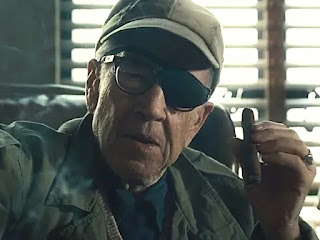 In one sense, this film has elements of Ed Wood in it, as it dabbles into the appeal of filmmaking. But, much like Spielberg's E.T.-The Extra-Terrestrial (1982) and Catch Me If You Can (2002), the film shows how divorce can impact a child. One thing I liked about the film was how neither Mitzi nor Burt are portrayed as uncaring. This makes their separation all the more painful when it does occur.
The entire cast is great, especially Lynch playing John Ford. The scene plays out pretty much the way Spielberg described the time he met Ford in the documentary Directed by John Ford. But the scene-stealer is definitely Williams, who makes the same memorable mark as Melinda Dillion, Dee Wallace, Frances O'Connor, and Kathryn Morris, all of whom played mothers in the respective Spielberg works Close Encounters of the Third Kind(1977), E.T., A.I.-Artificial Intelligence (2001), and Minority Report (2002).
It's also not surprising that Spielberg co-wrote the script along with Tony Kushner, who had penned Spielberg's previous works Munich, Lincoln, and West Side Story. The Fabelmans marks the fourth film Spielberg is credited with writing, after Close Encounters, Poltergeist (1982), and A.I.
Appropriately, Spielberg dedicates the film to his parents, both of whom passed on just a few years prior to the movie's release.
In one sense, this film has elements of Ed Wood in it, as it dabbles into the appeal of filmmaking. But, much like Spielberg's E.T.-The Extra-Terrestrial (1982) and Catch Me If You Can (2002), the film shows how divorce can impact a child. One thing I liked about the film was how neither Mitzi nor Burt are portrayed as uncaring. This makes their separation all the more painful when it does occur.
The entire cast is great, especially Lynch playing John Ford. The scene plays out pretty much the way Spielberg described the time he met Ford in the documentary Directed by John Ford. But the scene-stealer is definitely Williams, who makes the same memorable mark as Melinda Dillion, Dee Wallace, Frances O'Connor, and Kathryn Morris, all of whom played mothers in the respective Spielberg works Close Encounters of the Third Kind(1977), E.T., A.I.-Artificial Intelligence (2001), and Minority Report (2002).
It's also not surprising that Spielberg co-wrote the script along with Tony Kushner, who had penned Spielberg's previous works Munich, Lincoln, and West Side Story. The Fabelmans marks the fourth film Spielberg is credited with writing, after Close Encounters, Poltergeist (1982), and A.I.
Appropriately, Spielberg dedicates the film to his parents, both of whom passed on just a few years prior to the movie's release.


Thursday, January 16, 2020
All the President's Men (1976) vs. The Post (2017)
We are currently experiencing Trump's impeachment drama. This article looks at two films which focused on Nixon's.


With Donald Trump now officially the third US president to be impeached, here’s a look at two movies that focused on events which came close to making him the fourth. Both of these films involve journalists from the Washington Post going up against the Nixon White House as they discover and eventually make information public which would eventually lead to Nixon becoming the first United States president to resign in order to avoid impeachment.
So, which is better? Let’s find out.
All the President’s Men (1976)
This film, directed by Alan J. Pakula and based on the book of the same name by Washington Post reporters Carl Bernstein and Bob Woodward, begins with security guard Frank Wills (played by Wills himself) reporting that the Democratic National Committee headquarters at the Watergate complex in Washington D.C. has been broken into. Five men have been arrested, and the Post sends Woodward (Robert Redford) to cover the story.
At the arraignment of the five men, one of the accused (Richard Herd) informs Woodward that he and his four accomplices were all connected to the CIA. Investigating further, Woodward discovers the five are connected to Nixon’s White House Counsel. Although Woodward’s boss and editor Ben Bradlee (Jason Robards) doesn’t think the story is front page-worthy, he assigns Bernstein (Dustin Hoffman) to work with Woodward further on this.
Woodward goes to a parking garage and makes contact with his old acquaintance, who only goes by “Deep Throat” (Hal Holbrook). He cryptically informs Woodward to “follow the money”.
Soon, Woodward and Bernstein link the Watergate quintet to campaign contributions to Nixon’s re-election committee. But Bradlee still has his doubts, as Nixon was expected to easily defeat George McGovern in the 1972 election anyway.
The two reporters question Nixon’s former re-election treasurer Hugh Sloan (Stephen Collins) and learn that thousands of dollars were given to Nixon’s Chief of Staff and that the campaign was financing efforts to sabotage Democratic candidates well before the Watergate incident. This, and the White House’s subsequent denial of these events, prompt Bradlee to tell Woodward and Bernstein to keep digging.
Meeting with Deep Throat again, Woodward is told that Nixon’s Chief of Staff thought up the break-in and subsequent cover-up, which was also meant to cover the asses of both the CIA and FBI. Although Deep Throat tells Woodward that he and Bernstein are now targets, the duo, with Bradlee’s support, type out the full story just as Nixon is inaugurated again. The film ends with subsequent headlines announcing the cover-up and Nixon’s resignation.
The Post (2017)
This movie, directed by Steven Spielberg, begins in Vietnam in 1966. Daniel Ellsberg (Matthew Rhys) is a military analyst observing the troops and even getting a taste of combat as he accompanies troops into the jungle. On the subsequent plane ride home, Ellsberg tells Defense Secretary Robert McNamara (Bruce Greenwood) that there’s no sign of improvement regarding the military situation in Vietnam. However, upon landing, McNamara tells the press that everything is going smoothly. A few years later, Ellsberg clandestinely obtains and copies numerous documents about the Vietnam situation, soon to be known as the Pentagon Papers, which go back to Truman’s time in the Oval Office.
In 1971, Katharine Graham (Meryl Streep) is adjusting to her new role as the owner and publisher of the Washington Post. As she attempts to enact methods to help the paper financially, she finds she’s often at odds with both board member Arthur Parsons (Bradley Whitford) and the Post’s editor Ben Bradlee (previously played by Jason Robards, here played by Tom Hanks).
On top of that, Graham meets up with McNamara, who’s an old friend. He informs her that Ellsberg has given copies of the documents he obtained to the New York Times, along with other information. This results in anti-war protests intensifying. While Graham and Bradlee are angry that the Times is a step ahead of the Post, a subsequent court injunction prohibiting further articles on the matter puts them at ease.
Bradlee’s assistant Ben Bagdikian (Bob Odenkirk) eventually tracks down Ellsberg, whom he previously worked with. Ellsberg gives him the crapton of documents he copied, which Bagdikian quickly takes to Bradlee’s home. They and other Post reporters are soon pouring over all the pages, piecing the elaborate, decades-long deception together. But Parsons strongly advises not to publish the findings because the Nixon White House could easily retaliate and send them all to jail. Graham is also conflicted about doing so because of her friendship with McNamara, as is Bradlee upon learning that his late friend JFK was in the know about this deception as well.
Despite the legal challenges that are now coming her way, Graham gives Bradlee the go-ahead to publish the findings. Nixon’s retaliation leads to both the Post and the Times appearing before the Supreme Court, while other newspapers begin taking a cue from Graham. The court ends up ruling in favor of the Post and the Times, making Graham a hero in the eyes of many, and prompting Nixon to ban the Post from the White House.
The film ends with security guard Frank Wills (previously played by Wills himself, and here played by JaQwan J. Kelly) reporting a possible break-in at the Watergate complex.
Which is better?
If I had to give the edge to either film, it would be All the President’s Men. This may be because it was released first and less than two years after Nixon’s resignation. Hence, the effect of this complicated series of events regarding a war most of the American public had turned against by the start of the ’70s was still fresh in people’s minds. The film also benefits from a great cast and tense moments. This is all the more remarkable as there isn’t much action or bloodshed in this picture. The movie would go onto win four Oscars, including awards for Robards as well as William Goldman’s screenplay.
But this is not to say that The Post doesn’t have its good points. Like All the President’s Men, it has a great cast and Spielberg’s behind the scenes triumvirate of Michael Kahn (editing), Janusz Kaminski (cinematography) and John Williams (music) do their usual great jobs. One could also say that the ending nicely segues into the beginning of Pakula’s film, the same way that the ending of Rogue One segued nicely into the beginning of the original Star Wars film.
But The Post, which was dedicated to the late journalist/filmmaker Nora Ephron (who previously worked with both Streep and Hanks and was a neighbor of Spielberg’s), is actually more of a character study than a straight thriller like Pakula’s film. Despite Hanks’ above-the-title billing, his Bradlee, like Robards’, is essentially a supporting player, as Streep’s Graham is the center of the story. She must contend with holding her own as an executive in what was, at the time, a male-dominated field, while simultaneously facing the strong possibility of ruining the legacy left to her by her father and her late husband as she takes on the highest levels of government.
Just as Pakula’s film was released while the country was recovering from Watergate, Spielberg’s came out just as Trump was making noise about what the press was saying about him. Like Nixon, Trump is known for bitching about “fake news”, with probably the only difference being that Nixon didn’t have Twitter at his disposal. Regardless of what happens next with Trump’s current drama, both these films are wonderfully crafted dramas which should be required viewing for anyone interested in looking at a career in journalism.


With Donald Trump now officially the third US president to be impeached, here’s a look at two movies that focused on events which came close to making him the fourth. Both of these films involve journalists from the Washington Post going up against the Nixon White House as they discover and eventually make information public which would eventually lead to Nixon becoming the first United States president to resign in order to avoid impeachment.
So, which is better? Let’s find out.
All the President’s Men (1976)
This film, directed by Alan J. Pakula and based on the book of the same name by Washington Post reporters Carl Bernstein and Bob Woodward, begins with security guard Frank Wills (played by Wills himself) reporting that the Democratic National Committee headquarters at the Watergate complex in Washington D.C. has been broken into. Five men have been arrested, and the Post sends Woodward (Robert Redford) to cover the story.
At the arraignment of the five men, one of the accused (Richard Herd) informs Woodward that he and his four accomplices were all connected to the CIA. Investigating further, Woodward discovers the five are connected to Nixon’s White House Counsel. Although Woodward’s boss and editor Ben Bradlee (Jason Robards) doesn’t think the story is front page-worthy, he assigns Bernstein (Dustin Hoffman) to work with Woodward further on this.
Woodward goes to a parking garage and makes contact with his old acquaintance, who only goes by “Deep Throat” (Hal Holbrook). He cryptically informs Woodward to “follow the money”.
Soon, Woodward and Bernstein link the Watergate quintet to campaign contributions to Nixon’s re-election committee. But Bradlee still has his doubts, as Nixon was expected to easily defeat George McGovern in the 1972 election anyway.
The two reporters question Nixon’s former re-election treasurer Hugh Sloan (Stephen Collins) and learn that thousands of dollars were given to Nixon’s Chief of Staff and that the campaign was financing efforts to sabotage Democratic candidates well before the Watergate incident. This, and the White House’s subsequent denial of these events, prompt Bradlee to tell Woodward and Bernstein to keep digging.
Meeting with Deep Throat again, Woodward is told that Nixon’s Chief of Staff thought up the break-in and subsequent cover-up, which was also meant to cover the asses of both the CIA and FBI. Although Deep Throat tells Woodward that he and Bernstein are now targets, the duo, with Bradlee’s support, type out the full story just as Nixon is inaugurated again. The film ends with subsequent headlines announcing the cover-up and Nixon’s resignation.
The Post (2017)
This movie, directed by Steven Spielberg, begins in Vietnam in 1966. Daniel Ellsberg (Matthew Rhys) is a military analyst observing the troops and even getting a taste of combat as he accompanies troops into the jungle. On the subsequent plane ride home, Ellsberg tells Defense Secretary Robert McNamara (Bruce Greenwood) that there’s no sign of improvement regarding the military situation in Vietnam. However, upon landing, McNamara tells the press that everything is going smoothly. A few years later, Ellsberg clandestinely obtains and copies numerous documents about the Vietnam situation, soon to be known as the Pentagon Papers, which go back to Truman’s time in the Oval Office.
In 1971, Katharine Graham (Meryl Streep) is adjusting to her new role as the owner and publisher of the Washington Post. As she attempts to enact methods to help the paper financially, she finds she’s often at odds with both board member Arthur Parsons (Bradley Whitford) and the Post’s editor Ben Bradlee (previously played by Jason Robards, here played by Tom Hanks).
On top of that, Graham meets up with McNamara, who’s an old friend. He informs her that Ellsberg has given copies of the documents he obtained to the New York Times, along with other information. This results in anti-war protests intensifying. While Graham and Bradlee are angry that the Times is a step ahead of the Post, a subsequent court injunction prohibiting further articles on the matter puts them at ease.
Bradlee’s assistant Ben Bagdikian (Bob Odenkirk) eventually tracks down Ellsberg, whom he previously worked with. Ellsberg gives him the crapton of documents he copied, which Bagdikian quickly takes to Bradlee’s home. They and other Post reporters are soon pouring over all the pages, piecing the elaborate, decades-long deception together. But Parsons strongly advises not to publish the findings because the Nixon White House could easily retaliate and send them all to jail. Graham is also conflicted about doing so because of her friendship with McNamara, as is Bradlee upon learning that his late friend JFK was in the know about this deception as well.
Despite the legal challenges that are now coming her way, Graham gives Bradlee the go-ahead to publish the findings. Nixon’s retaliation leads to both the Post and the Times appearing before the Supreme Court, while other newspapers begin taking a cue from Graham. The court ends up ruling in favor of the Post and the Times, making Graham a hero in the eyes of many, and prompting Nixon to ban the Post from the White House.
The film ends with security guard Frank Wills (previously played by Wills himself, and here played by JaQwan J. Kelly) reporting a possible break-in at the Watergate complex.
Which is better?
If I had to give the edge to either film, it would be All the President’s Men. This may be because it was released first and less than two years after Nixon’s resignation. Hence, the effect of this complicated series of events regarding a war most of the American public had turned against by the start of the ’70s was still fresh in people’s minds. The film also benefits from a great cast and tense moments. This is all the more remarkable as there isn’t much action or bloodshed in this picture. The movie would go onto win four Oscars, including awards for Robards as well as William Goldman’s screenplay.
But this is not to say that The Post doesn’t have its good points. Like All the President’s Men, it has a great cast and Spielberg’s behind the scenes triumvirate of Michael Kahn (editing), Janusz Kaminski (cinematography) and John Williams (music) do their usual great jobs. One could also say that the ending nicely segues into the beginning of Pakula’s film, the same way that the ending of Rogue One segued nicely into the beginning of the original Star Wars film.
But The Post, which was dedicated to the late journalist/filmmaker Nora Ephron (who previously worked with both Streep and Hanks and was a neighbor of Spielberg’s), is actually more of a character study than a straight thriller like Pakula’s film. Despite Hanks’ above-the-title billing, his Bradlee, like Robards’, is essentially a supporting player, as Streep’s Graham is the center of the story. She must contend with holding her own as an executive in what was, at the time, a male-dominated field, while simultaneously facing the strong possibility of ruining the legacy left to her by her father and her late husband as she takes on the highest levels of government.
Just as Pakula’s film was released while the country was recovering from Watergate, Spielberg’s came out just as Trump was making noise about what the press was saying about him. Like Nixon, Trump is known for bitching about “fake news”, with probably the only difference being that Nixon didn’t have Twitter at his disposal. Regardless of what happens next with Trump’s current drama, both these films are wonderfully crafted dramas which should be required viewing for anyone interested in looking at a career in journalism.
Friday, December 16, 2016
Jaws and Taxi Driver
My latest Agony Booth work looks at two classics from the 1970s that have more in common than you may think.

 In a previous article, I noted that Jaws and Taxi Driver would make an ideal double feature.
The former, based on the Peter Benchley novel of the same name, is about a massive great white shark terrorizing an island community, while the latter is about the mental disintegration of a lonely insomniac. So on the one hand, these two movies, which were released within less than a year of each other, couldn’t be more different. But given that both were released in the middle of the American Film Renaissance of the 1970s, it can be argued that there’s a kinship of sorts between these two classics.
I first thought of this years ago when I read a book (for the life of me, I forget the name) which made comparisons of the films of different directors.
The book stated that in Jaws, Roy Scheider’s Martin Brody reveals that, despite his fear of water, he moved to the island of Amity to raise his kids in what he believed to be a safer environment than his native New York. The Big Apple is also the setting for Taxi Driver which, the author wrote, illustrated the reason why Brody went to Amity.
In addition, both Brody and Robert De Niro’s Travis Bickle are guys who aren’t looking to become public heroes. Brody is simply focused on raising his family and maintaining law and order in Amity, where he’s the chief of police. Bickle is a Vietnam vet who becomes a taxi driver simply as a way of coping with his psychological scars, even after he’s rejected by a beautiful political campaign worker named Betsy (Cybill Shepherd). Although the fact that he takes her to see a porno probably doesn’t help matters.
But both protagonists are compelled to take action as their respective stories go on. Brody must take his aquaphobia head on when the shark that’s been terrorizing Amity strikes again, nearly killing one of his sons. Likewise, Bickle feels obligated to help guide teenager Iris (Jodie Foster) out of the life of prostitution she’s trapped in.
Both men also face obstacles along their new journeys. Brody and oceanographer Matt Hooper (Richard Dreyfuss) have quite a time convincing Amity’s mayor Larry Vaughn (Murray Hamilton) to close the beaches, as doing so will drastically cut into the summer revenue Amity depends on to survive during the winter. But Brody eventually talks Vaughn into paying the huge fee that shark hunter Quint (Robert Shaw) has asked for in order to secure his boat and services towards stopping the shark. However, Quint turns out to have issues himself, which he basically explains to Brody and Hooper by revealing that he was one of the few survivors of the U.S.S. Indianapolis. That ship was sunk by a Japanese submarine toward the end of World War II, and nearly all the crewmen who survived the sinking were left in shark-infested waters for days before help finally arrived to save whoever was left. This mentality is what drives Quint to later burn out his ship’s engine, hence stranding the three of them in the middle of the ocean at the mercy of the shark. The beast manages to kill Quint and tear apart the shark cage Hooper is in before Brody blows it up by shooting an oxygen tank that’s in its mouth.
Bickle must contend with Sport (Harvey Keitel), Iris’s pimp. But while Brody is still able to keep his sanity in dealing with Quint, Bickle briefly loses his mind and attempts to murder presidential candidate Charles Palantine (Leonard Harris), whom Betsy is campaigning for. It’s only after this attempt ends in failure that Bickle goes to Sport’s hideout, where he proceeds to gun down him and others. Bickle is stopped from killing himself when he runs out of ammunition.
However, both ordeals produce the same result: the protagonists unexpectedly become heroes. The shark no longer terrorizes Amity (yes, I’m ignoring the Jaws sequels and I advise you to do the same), while Iris is returned to her family.
Jaws director Steven Spielberg and Taxi Driver director Martin Scorsese first met in the late 1960s as they were beginning to direct movies. By the mid-’70s, Spielberg had attained critical acclaim with Duel and The Sugarland Express, as had Scorsese with Mean Streets and Alice Doesn’t Live Here Anymore. But both Jaws and Taxi Driver would mark a turning point in their careers, and the making of both films proved difficult.
The production of Jaws was horrendous to say the least, mainly because of the mechanical shark not working properly as the salt water of the Atlantic Ocean (where the boat sequences were shot) kept damaging it. This caused the production to go over budget and over schedule, leading some to think it would flop when it reached cinemas.
During this time, however, some of Spielberg’s friends, including Scorsese, came by the set to give him moral support. These friends even suggested to Spielberg that the shark blow up in the film’s climax. This gave the movie a more exciting ending than the book, in which the shark drowns after being weighted down, and is one reason why this is one of only two movies that I believe are better than the book (for the record, the other is The Godfather).
Scorsese had trouble finding an actress to play Iris. Many young actresses (including Linda Blair and Mariel Hemingway) turned down the role because of the subject matter, before Foster (who previously worked with Scorsese in Alice Doesn’t Live Here Anymore) agreed to take the part. In addition, Scorsese also had to deal with the MPAA, which initially gave Taxi Driver the dreaded X rating for violence.
During post-production, Scorsese reportedly obtained the desired R rating by de-saturating the blood seen in the final shootout in order to make it less prominent. Spielberg also visited him and helped edit the last 10 minutes of the movie, as well as watched legendary composer Bernard Herrmann score what became his final movie (Scorsese tells a funny story about this on the special features section of the Vertigo DVD). Sadly, Herrmann died just one day after completing his work on the film.
The success of both of these films changed the course of American cinema. Jaws brought about the summer blockbuster phenomenon, while Taxi Driver influenced the world of independent films. Hence, without Jaws, we may not have had The Matrix (I’m ignoring those sequels, too), while without Taxi Driver, we may not have had Clerks (you know, the good Kevin Smith film).
These two films each received four Academy Award nominations, including Best Picture and Best Original Score. Infamously, both were locked out of the Best Director category. This illustrates how the success of these movies became a double-edged sword for their directors for a time.
Jaws began the association Spielberg ended up having with escapist entertainment (which later included Raiders of the Lost Ark and Jurassic Park), while Taxi Driver prompted people to associate Scorsese with more gritty fare (such as Goodfellas and Casino). This is why eyebrows were raised when they were later directing different types of films such as The Color Purple and The Age of Innocence.
But the two directors’ willingness to branch out in this manner is a reason why both are revered as the legends they are now. Heck, as far as I’m concerned, Spielberg and Scorsese have been doing those “experimental movies” that their pal George Lucas has been wasting his breath for years saying he plans to do.
However, both Jaws and Taxi Driver brought about less-than-desirable ramifications, as well.
Morons who didn’t know any better took Jaws as a message that all sharks should be hunted to extinction. As a result, there have been instances of massive shark hunting which has impacted not just the ocean, but humanity as well. Sharks keep the ecosystem in check by, among other things, keeping the zooplankton population down. Without sharks, zooplankton can increase overwhelmingly, making it impossible for people to enjoy activities on the beach. In addition, sharks have exceptional immune systems, which allow them to consume the carcinogens thrown into the ocean without being harmed. Hence, they help keep the oceans clean.
This is another reason why I prefer Jaws as a movie over the book: it clearly states that the shark in the story is not an ordinary shark! To his credit, Benchley, who co-wrote the Jaws screenplay with Carl Gottlieb (who had a small part in the movie), dedicated the rest of his life to preserving sharks before his passing in 2006. He even wrote a non-fiction book about sharks entitled Shark Trouble.
One person who saw Taxi Driver was a disturbed individual named John Hinckley, Jr. His fascination with Foster in that movie led him to take a page from Bickle’s book (including sporting the character’s mohawk) by attempting to assassinate President Ronald Reagan on March 30, 1981.
Shockingly, Hinckley’s attempt came close to being more successful than Bickle’s. A policeman and a Secret Service agent were both hit, while Press Secretary James Brady was shot in the head. Reagan himself was shot in the chest, but happily would make a complete recovery. The other three victims survived as well, although Brady’s wound left him paralyzed, and his death in 2014 was ruled a homicide as the result of the shooting. Hinckley was eventually found not guilty by reason of insanity. He was institutionalized until September 2016. At present, he lives with his mother in Williamsburg, Virginia.
Some may consider Jaws and Taxi Driver dubious achievements as movies, but there’s no denying the impact they, and by extension their respective directors, ended up having on both cinema and the world.


The former, based on the Peter Benchley novel of the same name, is about a massive great white shark terrorizing an island community, while the latter is about the mental disintegration of a lonely insomniac. So on the one hand, these two movies, which were released within less than a year of each other, couldn’t be more different. But given that both were released in the middle of the American Film Renaissance of the 1970s, it can be argued that there’s a kinship of sorts between these two classics.
I first thought of this years ago when I read a book (for the life of me, I forget the name) which made comparisons of the films of different directors.
The book stated that in Jaws, Roy Scheider’s Martin Brody reveals that, despite his fear of water, he moved to the island of Amity to raise his kids in what he believed to be a safer environment than his native New York. The Big Apple is also the setting for Taxi Driver which, the author wrote, illustrated the reason why Brody went to Amity.
In addition, both Brody and Robert De Niro’s Travis Bickle are guys who aren’t looking to become public heroes. Brody is simply focused on raising his family and maintaining law and order in Amity, where he’s the chief of police. Bickle is a Vietnam vet who becomes a taxi driver simply as a way of coping with his psychological scars, even after he’s rejected by a beautiful political campaign worker named Betsy (Cybill Shepherd). Although the fact that he takes her to see a porno probably doesn’t help matters.
But both protagonists are compelled to take action as their respective stories go on. Brody must take his aquaphobia head on when the shark that’s been terrorizing Amity strikes again, nearly killing one of his sons. Likewise, Bickle feels obligated to help guide teenager Iris (Jodie Foster) out of the life of prostitution she’s trapped in.
Both men also face obstacles along their new journeys. Brody and oceanographer Matt Hooper (Richard Dreyfuss) have quite a time convincing Amity’s mayor Larry Vaughn (Murray Hamilton) to close the beaches, as doing so will drastically cut into the summer revenue Amity depends on to survive during the winter. But Brody eventually talks Vaughn into paying the huge fee that shark hunter Quint (Robert Shaw) has asked for in order to secure his boat and services towards stopping the shark. However, Quint turns out to have issues himself, which he basically explains to Brody and Hooper by revealing that he was one of the few survivors of the U.S.S. Indianapolis. That ship was sunk by a Japanese submarine toward the end of World War II, and nearly all the crewmen who survived the sinking were left in shark-infested waters for days before help finally arrived to save whoever was left. This mentality is what drives Quint to later burn out his ship’s engine, hence stranding the three of them in the middle of the ocean at the mercy of the shark. The beast manages to kill Quint and tear apart the shark cage Hooper is in before Brody blows it up by shooting an oxygen tank that’s in its mouth.
Bickle must contend with Sport (Harvey Keitel), Iris’s pimp. But while Brody is still able to keep his sanity in dealing with Quint, Bickle briefly loses his mind and attempts to murder presidential candidate Charles Palantine (Leonard Harris), whom Betsy is campaigning for. It’s only after this attempt ends in failure that Bickle goes to Sport’s hideout, where he proceeds to gun down him and others. Bickle is stopped from killing himself when he runs out of ammunition.
However, both ordeals produce the same result: the protagonists unexpectedly become heroes. The shark no longer terrorizes Amity (yes, I’m ignoring the Jaws sequels and I advise you to do the same), while Iris is returned to her family.
Jaws director Steven Spielberg and Taxi Driver director Martin Scorsese first met in the late 1960s as they were beginning to direct movies. By the mid-’70s, Spielberg had attained critical acclaim with Duel and The Sugarland Express, as had Scorsese with Mean Streets and Alice Doesn’t Live Here Anymore. But both Jaws and Taxi Driver would mark a turning point in their careers, and the making of both films proved difficult.
The production of Jaws was horrendous to say the least, mainly because of the mechanical shark not working properly as the salt water of the Atlantic Ocean (where the boat sequences were shot) kept damaging it. This caused the production to go over budget and over schedule, leading some to think it would flop when it reached cinemas.
During this time, however, some of Spielberg’s friends, including Scorsese, came by the set to give him moral support. These friends even suggested to Spielberg that the shark blow up in the film’s climax. This gave the movie a more exciting ending than the book, in which the shark drowns after being weighted down, and is one reason why this is one of only two movies that I believe are better than the book (for the record, the other is The Godfather).
Scorsese had trouble finding an actress to play Iris. Many young actresses (including Linda Blair and Mariel Hemingway) turned down the role because of the subject matter, before Foster (who previously worked with Scorsese in Alice Doesn’t Live Here Anymore) agreed to take the part. In addition, Scorsese also had to deal with the MPAA, which initially gave Taxi Driver the dreaded X rating for violence.
During post-production, Scorsese reportedly obtained the desired R rating by de-saturating the blood seen in the final shootout in order to make it less prominent. Spielberg also visited him and helped edit the last 10 minutes of the movie, as well as watched legendary composer Bernard Herrmann score what became his final movie (Scorsese tells a funny story about this on the special features section of the Vertigo DVD). Sadly, Herrmann died just one day after completing his work on the film.
The success of both of these films changed the course of American cinema. Jaws brought about the summer blockbuster phenomenon, while Taxi Driver influenced the world of independent films. Hence, without Jaws, we may not have had The Matrix (I’m ignoring those sequels, too), while without Taxi Driver, we may not have had Clerks (you know, the good Kevin Smith film).
These two films each received four Academy Award nominations, including Best Picture and Best Original Score. Infamously, both were locked out of the Best Director category. This illustrates how the success of these movies became a double-edged sword for their directors for a time.
Jaws began the association Spielberg ended up having with escapist entertainment (which later included Raiders of the Lost Ark and Jurassic Park), while Taxi Driver prompted people to associate Scorsese with more gritty fare (such as Goodfellas and Casino). This is why eyebrows were raised when they were later directing different types of films such as The Color Purple and The Age of Innocence.
But the two directors’ willingness to branch out in this manner is a reason why both are revered as the legends they are now. Heck, as far as I’m concerned, Spielberg and Scorsese have been doing those “experimental movies” that their pal George Lucas has been wasting his breath for years saying he plans to do.
However, both Jaws and Taxi Driver brought about less-than-desirable ramifications, as well.
Morons who didn’t know any better took Jaws as a message that all sharks should be hunted to extinction. As a result, there have been instances of massive shark hunting which has impacted not just the ocean, but humanity as well. Sharks keep the ecosystem in check by, among other things, keeping the zooplankton population down. Without sharks, zooplankton can increase overwhelmingly, making it impossible for people to enjoy activities on the beach. In addition, sharks have exceptional immune systems, which allow them to consume the carcinogens thrown into the ocean without being harmed. Hence, they help keep the oceans clean.
This is another reason why I prefer Jaws as a movie over the book: it clearly states that the shark in the story is not an ordinary shark! To his credit, Benchley, who co-wrote the Jaws screenplay with Carl Gottlieb (who had a small part in the movie), dedicated the rest of his life to preserving sharks before his passing in 2006. He even wrote a non-fiction book about sharks entitled Shark Trouble.
One person who saw Taxi Driver was a disturbed individual named John Hinckley, Jr. His fascination with Foster in that movie led him to take a page from Bickle’s book (including sporting the character’s mohawk) by attempting to assassinate President Ronald Reagan on March 30, 1981.
Shockingly, Hinckley’s attempt came close to being more successful than Bickle’s. A policeman and a Secret Service agent were both hit, while Press Secretary James Brady was shot in the head. Reagan himself was shot in the chest, but happily would make a complete recovery. The other three victims survived as well, although Brady’s wound left him paralyzed, and his death in 2014 was ruled a homicide as the result of the shooting. Hinckley was eventually found not guilty by reason of insanity. He was institutionalized until September 2016. At present, he lives with his mother in Williamsburg, Virginia.
Some may consider Jaws and Taxi Driver dubious achievements as movies, but there’s no denying the impact they, and by extension their respective directors, ended up having on both cinema and the world.
Thursday, November 3, 2016
Double Features
My latest Agony Booth article goes into nice ideas for double features.
 Double features are almost as old as cinema itself. Before TV came around, a movie would be preceded by an animated short, a live-action short, a newsreel, and then the main feature. During the Great Depression, cinemas began to give customers two movies for the price of one in order to attract more ticket buyers. These presentations initially began with a low-budget film (the B-movie) before an interlude and then the main feature. This allowed studios that specialized in making B-movies, such as Republic, to become successful.
The revenue this generated soon led to major studios making their own B-movie features. This practice continues to thrive today, only nowadays these movies usually go straight to video (or streaming). Thanks to the advent of home video and later the internet, people can now have double features of all kinds in their own homes. Here now (in no particular order) are 10 great double features you can have at home and why I find them ideal.
Star Wars (1977)/Halloween (1978): These two films respectively rewrote the books on science fiction and horror (for good and bad, according to some) as it didn’t take long for imitators of both movies to flood cinemas in the wake of their successes. As it turns out, the villains in these movies (Darth Vader and Michael Myers) also wear what would become awesome Halloween costumes. Even the musical scores for both movies have become iconic, and rightly so. In addition, the first sequels for each film (The Empire Strikes Back and Halloween II) can make an ideal double feature since they each brought family connections into the narrative, influencing the directions of their respective franchises (again, for good and bad, according to some fans).
Hang ‘Em High (1968)/Night of the Living Dead (1968): By the end of the 1960s, Italian studios were basically churning out westerns and zombie pictures like they were pizzas. While neither of these films were Italian productions, both capitalized on that craze. Hang ‘Em High, Clint Eastwood’s first American-made western after the three he did with Sergio Leone made him a film star, involves a rancher (Eastwood) who survives a lynching and becomes deputized before hunting down the men who tried to kill him. Night of the Living Dead, an inexpensive production made in Pittsburgh, centers on a group of people who become trapped in a deserted house as reanimated corpses begin engulfing the countryside. Both movies have a gritty, harsh tone, and the fact that both premiered just after the shocking murders of Martin Luther King and Robert Kennedy may have made both films cathartic, if you will, for viewers.
Jaws (1975)/Taxi Driver (1976): I actually plan to go into more detail about these two movies at a later time. Needless to say, however, Jaws, Steven Spielberg’s classic film of a shark terrorizing an island community, set the bar when it came to blockbusters, while Taxi Driver, Martin Scorsese’s classic picture about a loner (Robert De Niro) who ends up committing terrifying acts, did the same for independent films. One could also say they ended up coloring the public’s perceptions of their respective directors.
High Noon (1952)/Rio Bravo (1959): Two classic westerns released during the genre’s heyday. The former, in which Gary Cooper ends up facing bad guys alone when nobody is willing to assist him, was viewed as a critique of McCarthyism for the manner in which Cooper does the honorable thing. The latter, in which John Wayne fights bad guys with loyal men at his side, was viewed as a counterpoint to that argument, as Wayne’s character doesn’t spend much of the movie asking for assistance. Wayne even called High Noon “un-American”, which is what led to him and director Howard Hawks making Bravo. Regardless of political views, today both movies are rightfully embraced as masterpieces.
The NeverEnding Story (1984)/Labyrinth (1986): Both of these films involve young people who must enter a world they know from a book in order to save lives. NeverEnding Story centers on a lonely boy (Barret Oliver) reading a fantasy book, and as he reaches the end, he realizes that he’s the only one who can save a not-so-fictional land from destruction. Labyrinth stars then-unknown Jennifer Connelly as a fantasy-loving teenager who just wants to live in her own fantasy world and regrets her wish that her infant brother be taken away by the Goblin King (the late, great David Bowie), a character from the play she’s reading. She must then enter that fantasy world to save her brother, dealing with the Goblin King and his minions (created by the late, great Jim Henson). One could also say that both movies make a great argument for why reading is good.
Ghostbusters (1984)/Beetlejuice (1988): Two comedy classics involving ghosts. Ghostbusters centers on four men (Bill Murray, Dan Aykroyd, Ernie Hudson, and the late Harold Ramis) who manage to make a lucrative business out of capturing ghosts. In lesser hands, Beetlejuice could have been just a Ghostbusters knock-off, but Tim Burton stirs things up with his film by making ghosts the main characters. In that film, a couple (Alec Baldwin and Geena Davis) have recently died and soon enlist the aid of the title character (Michael Keaton) to rid their home of its new owners, an act that they come to regret, as he has a reputation for wrecking havoc among both the living and the dead. Add the fact that both of these movies are hilarious and you have a great double feature.
The Terminator (1984)/Back to the Future (1985): Two time travel stories released in consecutive years. The first, which involves a murderous cyborg (Arnold Schwarzenegger) sent back through time to change history by killing a woman (Linda Hamilton) before she can give birth to the man who will save humanity, was a nerve-jolting thriller, while the second, in which a teenager (Michael J. Fox) accidentally goes back in time thanks to a DeLorean his scientist friend (Christopher Lloyd) has modified, was a comedy. Both films also end up giving nice messages about the importance of believing in yourself and creating your own destiny.
Escape from New York (1981)/Blade Runner (1982): Both of these are science fiction films which show a near future with a dark, apocalyptic outlook that continues to influence the science fiction genre to this day. Escape from New York, which takes place in 1997, involves a criminal (Kurt Russell) being drafted into rescuing the President of the United States (Donald Pleasence) by going into the title city (which is now a maximum security prison), where Air Force One crashed and the president was kidnapped by the dangerous criminals who now inhabit the city. Blade Runner involves a police detective (Harrison Ford) who must go through 2019 Los Angeles to terminate dangerous androids (Rutger Hauer, Daryl Hannah, Joanna Cassidy, and Brion James) who have arrived on Earth (where androids are banned) after violently escaping from an outer space colony (three more years to go as of this writing—let’s see if those colonies come about by then). Another interesting contrast is that Escape contains criticism of police and police actions (one of the characters in the film refers to the U.S. as a fascist state), while Ford’s character in Blade Runner spends much of the movie questioning himself and his actions, especially when he realizes his opponents aren’t as evil as society and his superiors have made them out to be.
Ray (2004)/Walk the Line (2005): Two biopics about music legends. Ray depicts the rise of Ray Charles (a brilliant, Oscar-winning Jamie Foxx) while Walk the Line does the same with music duo Johnny and June Carter Cash (Joaquin Phoenix and a brilliant, Oscar-winning Reese Witherspoon). Both movies do a fine job illustrating the trials and tribulations these artists went through (some of which were of their own making) as they fulfilled their dreams of making music, and thus, ensuring their places in history. Interestingly, both Charles and the Cashes passed away shortly before these films premiered, although both movies received their blessing.
The Rocky Horror Picture Show (1975)/Clue (1985): Rocky Horror (which, I must confess, I never really liked, but can understand why many do) is a musical-science fiction-comedy with not-so-subtle nods to Frankenstein, while Clue is a mystery-comedy based on the Parker Brothers board game of the same name. However, both films not only take place in mansions on dark and stormy nights, but both also feature memorable roles for Tim Curry. In Rocky Horror, he plays the doctor who was once described by Us magazine as “a bi-sexual Beetlejuice”, while in Clue, he plays a butler who ends up setting an evening of murder into motion after he invites several people over for dinner. In addition, both movies didn’t get much initial notice when they were released, but today have huge followings as well as midnight showings with audience members performing the action as it plays on screen.
HONORABLE MENTION: It’s the Great Pumpkin, Charlie Brown (1966)/Garfield’s Halloween Adventure (1985): As it’s Halloween, it seems appropriate to mention these two animated specials, which may be the most famous of all Halloween cartoons. In the first, Linus waits for the arrival of the Santa Claus-esque Great Pumpkin, while Charlie Brown ends up getting only rocks while trick-or-treating and Snoopy hunts for the Red Baron. In the second, Garfield enlists his dog sidekick Odie to go trick-or-treating with him (both dress up as pirates) in order to get more candy for himself, only for both to get caught up in a genuine ghost story (involving—what else?—pirates, which today reminds me a little of the setting of John Carpenter’s The Fog). The Garfield special actually bests Great Pumpkin in terms of having moments that make you jump, but both specials have a great deal of heart, making them the perfect Halloween treats for all ages.

The revenue this generated soon led to major studios making their own B-movie features. This practice continues to thrive today, only nowadays these movies usually go straight to video (or streaming). Thanks to the advent of home video and later the internet, people can now have double features of all kinds in their own homes. Here now (in no particular order) are 10 great double features you can have at home and why I find them ideal.
Star Wars (1977)/Halloween (1978): These two films respectively rewrote the books on science fiction and horror (for good and bad, according to some) as it didn’t take long for imitators of both movies to flood cinemas in the wake of their successes. As it turns out, the villains in these movies (Darth Vader and Michael Myers) also wear what would become awesome Halloween costumes. Even the musical scores for both movies have become iconic, and rightly so. In addition, the first sequels for each film (The Empire Strikes Back and Halloween II) can make an ideal double feature since they each brought family connections into the narrative, influencing the directions of their respective franchises (again, for good and bad, according to some fans).
Hang ‘Em High (1968)/Night of the Living Dead (1968): By the end of the 1960s, Italian studios were basically churning out westerns and zombie pictures like they were pizzas. While neither of these films were Italian productions, both capitalized on that craze. Hang ‘Em High, Clint Eastwood’s first American-made western after the three he did with Sergio Leone made him a film star, involves a rancher (Eastwood) who survives a lynching and becomes deputized before hunting down the men who tried to kill him. Night of the Living Dead, an inexpensive production made in Pittsburgh, centers on a group of people who become trapped in a deserted house as reanimated corpses begin engulfing the countryside. Both movies have a gritty, harsh tone, and the fact that both premiered just after the shocking murders of Martin Luther King and Robert Kennedy may have made both films cathartic, if you will, for viewers.
Jaws (1975)/Taxi Driver (1976): I actually plan to go into more detail about these two movies at a later time. Needless to say, however, Jaws, Steven Spielberg’s classic film of a shark terrorizing an island community, set the bar when it came to blockbusters, while Taxi Driver, Martin Scorsese’s classic picture about a loner (Robert De Niro) who ends up committing terrifying acts, did the same for independent films. One could also say they ended up coloring the public’s perceptions of their respective directors.
High Noon (1952)/Rio Bravo (1959): Two classic westerns released during the genre’s heyday. The former, in which Gary Cooper ends up facing bad guys alone when nobody is willing to assist him, was viewed as a critique of McCarthyism for the manner in which Cooper does the honorable thing. The latter, in which John Wayne fights bad guys with loyal men at his side, was viewed as a counterpoint to that argument, as Wayne’s character doesn’t spend much of the movie asking for assistance. Wayne even called High Noon “un-American”, which is what led to him and director Howard Hawks making Bravo. Regardless of political views, today both movies are rightfully embraced as masterpieces.
The NeverEnding Story (1984)/Labyrinth (1986): Both of these films involve young people who must enter a world they know from a book in order to save lives. NeverEnding Story centers on a lonely boy (Barret Oliver) reading a fantasy book, and as he reaches the end, he realizes that he’s the only one who can save a not-so-fictional land from destruction. Labyrinth stars then-unknown Jennifer Connelly as a fantasy-loving teenager who just wants to live in her own fantasy world and regrets her wish that her infant brother be taken away by the Goblin King (the late, great David Bowie), a character from the play she’s reading. She must then enter that fantasy world to save her brother, dealing with the Goblin King and his minions (created by the late, great Jim Henson). One could also say that both movies make a great argument for why reading is good.
Ghostbusters (1984)/Beetlejuice (1988): Two comedy classics involving ghosts. Ghostbusters centers on four men (Bill Murray, Dan Aykroyd, Ernie Hudson, and the late Harold Ramis) who manage to make a lucrative business out of capturing ghosts. In lesser hands, Beetlejuice could have been just a Ghostbusters knock-off, but Tim Burton stirs things up with his film by making ghosts the main characters. In that film, a couple (Alec Baldwin and Geena Davis) have recently died and soon enlist the aid of the title character (Michael Keaton) to rid their home of its new owners, an act that they come to regret, as he has a reputation for wrecking havoc among both the living and the dead. Add the fact that both of these movies are hilarious and you have a great double feature.
The Terminator (1984)/Back to the Future (1985): Two time travel stories released in consecutive years. The first, which involves a murderous cyborg (Arnold Schwarzenegger) sent back through time to change history by killing a woman (Linda Hamilton) before she can give birth to the man who will save humanity, was a nerve-jolting thriller, while the second, in which a teenager (Michael J. Fox) accidentally goes back in time thanks to a DeLorean his scientist friend (Christopher Lloyd) has modified, was a comedy. Both films also end up giving nice messages about the importance of believing in yourself and creating your own destiny.
Escape from New York (1981)/Blade Runner (1982): Both of these are science fiction films which show a near future with a dark, apocalyptic outlook that continues to influence the science fiction genre to this day. Escape from New York, which takes place in 1997, involves a criminal (Kurt Russell) being drafted into rescuing the President of the United States (Donald Pleasence) by going into the title city (which is now a maximum security prison), where Air Force One crashed and the president was kidnapped by the dangerous criminals who now inhabit the city. Blade Runner involves a police detective (Harrison Ford) who must go through 2019 Los Angeles to terminate dangerous androids (Rutger Hauer, Daryl Hannah, Joanna Cassidy, and Brion James) who have arrived on Earth (where androids are banned) after violently escaping from an outer space colony (three more years to go as of this writing—let’s see if those colonies come about by then). Another interesting contrast is that Escape contains criticism of police and police actions (one of the characters in the film refers to the U.S. as a fascist state), while Ford’s character in Blade Runner spends much of the movie questioning himself and his actions, especially when he realizes his opponents aren’t as evil as society and his superiors have made them out to be.
Ray (2004)/Walk the Line (2005): Two biopics about music legends. Ray depicts the rise of Ray Charles (a brilliant, Oscar-winning Jamie Foxx) while Walk the Line does the same with music duo Johnny and June Carter Cash (Joaquin Phoenix and a brilliant, Oscar-winning Reese Witherspoon). Both movies do a fine job illustrating the trials and tribulations these artists went through (some of which were of their own making) as they fulfilled their dreams of making music, and thus, ensuring their places in history. Interestingly, both Charles and the Cashes passed away shortly before these films premiered, although both movies received their blessing.
The Rocky Horror Picture Show (1975)/Clue (1985): Rocky Horror (which, I must confess, I never really liked, but can understand why many do) is a musical-science fiction-comedy with not-so-subtle nods to Frankenstein, while Clue is a mystery-comedy based on the Parker Brothers board game of the same name. However, both films not only take place in mansions on dark and stormy nights, but both also feature memorable roles for Tim Curry. In Rocky Horror, he plays the doctor who was once described by Us magazine as “a bi-sexual Beetlejuice”, while in Clue, he plays a butler who ends up setting an evening of murder into motion after he invites several people over for dinner. In addition, both movies didn’t get much initial notice when they were released, but today have huge followings as well as midnight showings with audience members performing the action as it plays on screen.
HONORABLE MENTION: It’s the Great Pumpkin, Charlie Brown (1966)/Garfield’s Halloween Adventure (1985): As it’s Halloween, it seems appropriate to mention these two animated specials, which may be the most famous of all Halloween cartoons. In the first, Linus waits for the arrival of the Santa Claus-esque Great Pumpkin, while Charlie Brown ends up getting only rocks while trick-or-treating and Snoopy hunts for the Red Baron. In the second, Garfield enlists his dog sidekick Odie to go trick-or-treating with him (both dress up as pirates) in order to get more candy for himself, only for both to get caught up in a genuine ghost story (involving—what else?—pirates, which today reminds me a little of the setting of John Carpenter’s The Fog). The Garfield special actually bests Great Pumpkin in terms of having moments that make you jump, but both specials have a great deal of heart, making them the perfect Halloween treats for all ages.
Wednesday, April 23, 2014
Agony Booth review: War of the Worlds (2005)
My latest Agony Booth review is of Steven Spielberg's exciting take on War of the Worlds.
 I’m going to admit right up front that I really liked this movie. In fact, while I wouldn’t go so far as to say that it’s one of Steven Spielberg’s best, his version of War of the Worlds is high up there on the rather short list of remakes that are actually better than the originals.
Before the 1953 film, the story was famously adapted for radio by the great Orson Welles, and it scared the hell out of people on Halloween night, 1938. And it just so happens that both Welles and Spielberg were labeled “boy wonders” because of their directorial successes at an early age. Spielberg was a big fan of the original film, so perhaps it was only inevitable that he would make his own version of the story. While to some, this movie may appear to be War of the Worlds in name only (after all, we never get an appearance from anybody named Dr. Clayton Forrester), Spielberg’s take retains the spirit of the original work, and even includes a bit more material from the original H.G. Wells novel.
Just as in the novel, the film begins with a narrator (Morgan Freeman) telling us that humanity has been blissfully unaware that an alien intelligence has long been watching us, and waiting for the right time to strike. We then cut to New Jersey, where Ray Ferrier (Tom Cruise) is finishing up his work day as a crane operator. He then races home to meet up with his pregnant ex-wife (Miranda Otto) who’s dropping off their children Rachel (Dakota Fanning) and Robbie (Justin Chatwin), so that Ray can babysit them while she and her new husband go to Boston to visit her parents.
Ray proves that he’s not exactly father of the year by being late to meet his kids, and later on by arguing with Robbie as they play catch (which ends with Ray angrily throwing a ball through one of his own windows).
Ray then goes off to nap, telling Rachel to order some food if she’s hungry (I guess this means the ten year old has her own credit card?). At the same time, reports come in of unusual lightning storms all over the world, resulting in lots of blackouts and electronic devices going dead. Ray wakes up, and after expressing his dislike for the healthy food Rachel ordered (next time, just get pizza for your kids, pal), he learns that Robbie took off in his car without permission.
Ray goes after him, and in the process encounters one of the disturbances he heard about via the news. Dark clouds suddenly appear in the skies, and lightning repeatedly hits the center of town, and just as quickly, the storm vanishes.
Ray finds Robbie, then goes to investigate the exact spot where those lightning strikes hit. A crowd has gathered around a giant hole in the pavement, which then begins to grow, causing all the neighborhood streets to break apart and buildings to collapse. The crowd then sees a huge, three-legged machine rise up from the ground. It proceeds to shoot out laser beams that vaporize anything and everything in its path, and never was the phrase “ashes to ashes” more apt.
Ray escapes the machine and its death ray and makes it home, in shock and covered in the dust that was once his neighbors. But he manages to pull himself together and pack up his kids and some supplies.
They miraculously get hold of the only working car for miles around and drive away just as their entire neighborhood gets obliterated. They make it to his ex-wife’s suburban home, which is currently empty, so Ray gets his kids ready to sleep down in the basement. Alas, they don’t get much sleep once they hear a horrific noise outside. In the dawn light, Ray discovers that a Boeing 747 has crashed into the neighborhood.
While searching the wreckage, Ray encounters a small TV news crew. The reporter tells Ray that these machines, nicknamed “tripods”, are also attacking other parts of the world. And just like in the original movie, the machines are equipped with force fields that prevent any human weapons from so much as making a scratch on them.
The reporter shows him footage of the original lightning strikes, and slows it down to show how the “lightning” was really a small capsule flying down from the sky and burrowing into the ground. Meaning, the tripods must have been buried underground many years before.
Ray then decides to head to Boston to reunite the kids with their mom. But Robbie is determined to join up with a passing military convoy to fight the aliens. He expresses his disgust for Ray, knowing he simply wants to get them to Boston so he can dump them off on their mother.
At the same time, a nice freaky moment occurs when Rachel walks off to find privacy to relieve herself. She sees a dead body floating down the river, followed by dozens more. Things get worse as they continue on their way to Boston, only to find themselves surrounded by an angry mob who steals their car away. Ray and the kids then attempt to get on a ferry going across the Hudson River, but the aliens cause the ferry to sink, forcing everyone to swim to safety.
Robbie is determined to join the soldiers in fighting the aliens, and Ray is stuck in a situation where he has to choose between saving Rachel and letting Robbie go. Eventually, he decides to save Rachel, and he and the girl are offered shelter by a guy named Harlan Ogilvy (Tim Robbins). But Ogilvy (a name taken from the novel) turns out to be a nutcase who has a mental breakdown when he looks outside and sees the aliens feeding on the blood of humans. His ranting and raving threatens to draw the aliens to their hiding place, leaving Ray no choice but to kill him (hey, I hated Howard the Duck as much as the next guy, but Robbins shouldn’t be blamed for that!).
Then comes the film’s most intense sequence, as the aliens hunt for Ray and Rachel in Ogilvy’s house using a long, snake-like periscope (similar to the one seen in the 1953 movie) and manage to find them. They run outside, where a tripod scoops them up. They’re thrown into a cage-like structure with other prisoners, but luckily, Ray was earlier able to snag some grenades from an abandoned army jeep. He pulls the pins and the resulting explosion brings the tripod to the ground.
This frees everyone, and Ray and Rachel finally manage to get to Boston, which isn’t as devastated as you’d think, given the circumstances. When they arrive, they realize that the tripods are starting to weaken. Because he’s the lead character, Ray informs the nearby military of something you’d think they would have noticed on their own already: the tripods no longer have their force fields. Once they’re told the obvious, the soldiers fire at will and destroy the alien invaders.
Ray finally delivers Rachel to her mom, who’s staying with her parents (Gene Barry and Ann Robinson, the stars of the 1953 film). Also here is Robbie, who’s miraculously survived, even though the last time we saw him he was with the army heading over a hill into a massive wall of fire. Morgan Freeman’s narration returns to inform us that, just like in the novel, the aliens were brought down because of their lack of immunity to Earth bacteria. In other words, they were smarter than the aliens in Signs because it wasn’t just plain old tap water that did them in.
The film has some head-scratching moments. Many have taken issue with Robbie surviving at the movie’s end, but perhaps the biggest WTF moment for me was why the aliens left their machines in the ground for God knows how long, and yet no one ever came across them.
But overall, the film picks up after a slow start and remains exciting until the end. The scenes with the aliens hunting people are as intense as those of dinosaurs doing the same in Spielberg’s Jurassic Park. The 1953 original was released during an era of Cold War tensions with the Soviet Union, and in their place, Spielberg’s version is made with 9/11 sensibilities (“Is it terrorists?” Robbie asks at one point in the film, and when Ray is covered in the dust of victims, it’s hard not to draw parallels to the WTC dust that covered Manhattan), which gives this movie a timely feel.
I was skeptical about a remake of War of the Worlds initially, because I thought that it had already basically been remade nine years earlier as Independence Day. Thankfully, this film manages to be different from ID4 because it’s told entirely from the POV of everyday people just trying to survive, as opposed to top bureaucrats and heads of state tasked with stopping the aliens. In an issue of Entertainment Weekly, Stephen King named the film one of the best films of 2005, calling it “human science fiction, and that’s a rarity.”
This brings us to the movie’s star. Cruise is as fine here as he was in his previous film with Spielberg, Minority Report. While we may question Ray’s parenting skills, Cruise does a good job of playing a blue-collar everyman who’s simply trying to protect his children. In another nice touch, Cruise’s usual smirking, hotshot action movie persona is subverted here, as the movie makes it clear that his character is in way over his head. One of his best moments is when Rachel asks him to sing her to sleep and Ray realizes he doesn’t know any bedtime songs, so he starts tearfully singing the Beach Boys as a lullaby.
Like basically all of Spielberg’s films, the production values are top notch. The visual effects are good without being overdone, and John Williams delivers another exciting musical score. The aliens themselves are nicely done by ILM, and it’s a nice change of pace seeing aliens in a Spielberg film that aren’t as benevolent as those of Close Encounters and E.T.
Some complained that Dakota Fanning as Rachel does nothing but shriek for the whole movie, but she and Chatwin are believable as kids caught up in something terrifying and otherworldly, to say the least.
Although the movie was financially successful, this was in a way the beginning of the end of the public’s affection for Tom Cruise, who was making headlines at the time for jumping on Oprah’s couch and hooking up with Katie Holmes and fighting with Brooke Shields about postpartum depression. This tabloid fodder ended up overshadowing the movie itself.
But the film reminds us it’s not an accident that, for a time, Cruise was a real force to be reckoned with in Hollywood. One reason for this is that as his star rose, Cruise set out to work with the best people, not necessarily those who would kiss his ass. This is why he has a nice who’s-who’s of directors in his filmography, including Spielberg, Martin Scorsese, Stanley Kubrick, Oliver Stone, and Michael Mann.
While the Mission: Impossible sequels are still bringing in the money for Cruise (with a fifth installment due next year), it’d be nice if he was able to make good movies again, rather than churning out junk like Oblivion and the upcoming Edge of Tomorrow.
War of the Worlds, despite a few hiccups in logic, succeeds in its objective, which is to deliver thrilling entertainment. It gives blockbusters with big stars and great special effects a good name.

Before the 1953 film, the story was famously adapted for radio by the great Orson Welles, and it scared the hell out of people on Halloween night, 1938. And it just so happens that both Welles and Spielberg were labeled “boy wonders” because of their directorial successes at an early age. Spielberg was a big fan of the original film, so perhaps it was only inevitable that he would make his own version of the story. While to some, this movie may appear to be War of the Worlds in name only (after all, we never get an appearance from anybody named Dr. Clayton Forrester), Spielberg’s take retains the spirit of the original work, and even includes a bit more material from the original H.G. Wells novel.
Just as in the novel, the film begins with a narrator (Morgan Freeman) telling us that humanity has been blissfully unaware that an alien intelligence has long been watching us, and waiting for the right time to strike. We then cut to New Jersey, where Ray Ferrier (Tom Cruise) is finishing up his work day as a crane operator. He then races home to meet up with his pregnant ex-wife (Miranda Otto) who’s dropping off their children Rachel (Dakota Fanning) and Robbie (Justin Chatwin), so that Ray can babysit them while she and her new husband go to Boston to visit her parents.
Ray proves that he’s not exactly father of the year by being late to meet his kids, and later on by arguing with Robbie as they play catch (which ends with Ray angrily throwing a ball through one of his own windows).
Ray then goes off to nap, telling Rachel to order some food if she’s hungry (I guess this means the ten year old has her own credit card?). At the same time, reports come in of unusual lightning storms all over the world, resulting in lots of blackouts and electronic devices going dead. Ray wakes up, and after expressing his dislike for the healthy food Rachel ordered (next time, just get pizza for your kids, pal), he learns that Robbie took off in his car without permission.
Ray goes after him, and in the process encounters one of the disturbances he heard about via the news. Dark clouds suddenly appear in the skies, and lightning repeatedly hits the center of town, and just as quickly, the storm vanishes.
Ray finds Robbie, then goes to investigate the exact spot where those lightning strikes hit. A crowd has gathered around a giant hole in the pavement, which then begins to grow, causing all the neighborhood streets to break apart and buildings to collapse. The crowd then sees a huge, three-legged machine rise up from the ground. It proceeds to shoot out laser beams that vaporize anything and everything in its path, and never was the phrase “ashes to ashes” more apt.
Ray escapes the machine and its death ray and makes it home, in shock and covered in the dust that was once his neighbors. But he manages to pull himself together and pack up his kids and some supplies.
They miraculously get hold of the only working car for miles around and drive away just as their entire neighborhood gets obliterated. They make it to his ex-wife’s suburban home, which is currently empty, so Ray gets his kids ready to sleep down in the basement. Alas, they don’t get much sleep once they hear a horrific noise outside. In the dawn light, Ray discovers that a Boeing 747 has crashed into the neighborhood.
While searching the wreckage, Ray encounters a small TV news crew. The reporter tells Ray that these machines, nicknamed “tripods”, are also attacking other parts of the world. And just like in the original movie, the machines are equipped with force fields that prevent any human weapons from so much as making a scratch on them.
The reporter shows him footage of the original lightning strikes, and slows it down to show how the “lightning” was really a small capsule flying down from the sky and burrowing into the ground. Meaning, the tripods must have been buried underground many years before.
Ray then decides to head to Boston to reunite the kids with their mom. But Robbie is determined to join up with a passing military convoy to fight the aliens. He expresses his disgust for Ray, knowing he simply wants to get them to Boston so he can dump them off on their mother.
At the same time, a nice freaky moment occurs when Rachel walks off to find privacy to relieve herself. She sees a dead body floating down the river, followed by dozens more. Things get worse as they continue on their way to Boston, only to find themselves surrounded by an angry mob who steals their car away. Ray and the kids then attempt to get on a ferry going across the Hudson River, but the aliens cause the ferry to sink, forcing everyone to swim to safety.
Robbie is determined to join the soldiers in fighting the aliens, and Ray is stuck in a situation where he has to choose between saving Rachel and letting Robbie go. Eventually, he decides to save Rachel, and he and the girl are offered shelter by a guy named Harlan Ogilvy (Tim Robbins). But Ogilvy (a name taken from the novel) turns out to be a nutcase who has a mental breakdown when he looks outside and sees the aliens feeding on the blood of humans. His ranting and raving threatens to draw the aliens to their hiding place, leaving Ray no choice but to kill him (hey, I hated Howard the Duck as much as the next guy, but Robbins shouldn’t be blamed for that!).
Then comes the film’s most intense sequence, as the aliens hunt for Ray and Rachel in Ogilvy’s house using a long, snake-like periscope (similar to the one seen in the 1953 movie) and manage to find them. They run outside, where a tripod scoops them up. They’re thrown into a cage-like structure with other prisoners, but luckily, Ray was earlier able to snag some grenades from an abandoned army jeep. He pulls the pins and the resulting explosion brings the tripod to the ground.
This frees everyone, and Ray and Rachel finally manage to get to Boston, which isn’t as devastated as you’d think, given the circumstances. When they arrive, they realize that the tripods are starting to weaken. Because he’s the lead character, Ray informs the nearby military of something you’d think they would have noticed on their own already: the tripods no longer have their force fields. Once they’re told the obvious, the soldiers fire at will and destroy the alien invaders.
Ray finally delivers Rachel to her mom, who’s staying with her parents (Gene Barry and Ann Robinson, the stars of the 1953 film). Also here is Robbie, who’s miraculously survived, even though the last time we saw him he was with the army heading over a hill into a massive wall of fire. Morgan Freeman’s narration returns to inform us that, just like in the novel, the aliens were brought down because of their lack of immunity to Earth bacteria. In other words, they were smarter than the aliens in Signs because it wasn’t just plain old tap water that did them in.
The film has some head-scratching moments. Many have taken issue with Robbie surviving at the movie’s end, but perhaps the biggest WTF moment for me was why the aliens left their machines in the ground for God knows how long, and yet no one ever came across them.
But overall, the film picks up after a slow start and remains exciting until the end. The scenes with the aliens hunting people are as intense as those of dinosaurs doing the same in Spielberg’s Jurassic Park. The 1953 original was released during an era of Cold War tensions with the Soviet Union, and in their place, Spielberg’s version is made with 9/11 sensibilities (“Is it terrorists?” Robbie asks at one point in the film, and when Ray is covered in the dust of victims, it’s hard not to draw parallels to the WTC dust that covered Manhattan), which gives this movie a timely feel.
I was skeptical about a remake of War of the Worlds initially, because I thought that it had already basically been remade nine years earlier as Independence Day. Thankfully, this film manages to be different from ID4 because it’s told entirely from the POV of everyday people just trying to survive, as opposed to top bureaucrats and heads of state tasked with stopping the aliens. In an issue of Entertainment Weekly, Stephen King named the film one of the best films of 2005, calling it “human science fiction, and that’s a rarity.”
This brings us to the movie’s star. Cruise is as fine here as he was in his previous film with Spielberg, Minority Report. While we may question Ray’s parenting skills, Cruise does a good job of playing a blue-collar everyman who’s simply trying to protect his children. In another nice touch, Cruise’s usual smirking, hotshot action movie persona is subverted here, as the movie makes it clear that his character is in way over his head. One of his best moments is when Rachel asks him to sing her to sleep and Ray realizes he doesn’t know any bedtime songs, so he starts tearfully singing the Beach Boys as a lullaby.
Like basically all of Spielberg’s films, the production values are top notch. The visual effects are good without being overdone, and John Williams delivers another exciting musical score. The aliens themselves are nicely done by ILM, and it’s a nice change of pace seeing aliens in a Spielberg film that aren’t as benevolent as those of Close Encounters and E.T.
Some complained that Dakota Fanning as Rachel does nothing but shriek for the whole movie, but she and Chatwin are believable as kids caught up in something terrifying and otherworldly, to say the least.
Although the movie was financially successful, this was in a way the beginning of the end of the public’s affection for Tom Cruise, who was making headlines at the time for jumping on Oprah’s couch and hooking up with Katie Holmes and fighting with Brooke Shields about postpartum depression. This tabloid fodder ended up overshadowing the movie itself.
But the film reminds us it’s not an accident that, for a time, Cruise was a real force to be reckoned with in Hollywood. One reason for this is that as his star rose, Cruise set out to work with the best people, not necessarily those who would kiss his ass. This is why he has a nice who’s-who’s of directors in his filmography, including Spielberg, Martin Scorsese, Stanley Kubrick, Oliver Stone, and Michael Mann.
While the Mission: Impossible sequels are still bringing in the money for Cruise (with a fifth installment due next year), it’d be nice if he was able to make good movies again, rather than churning out junk like Oblivion and the upcoming Edge of Tomorrow.
War of the Worlds, despite a few hiccups in logic, succeeds in its objective, which is to deliver thrilling entertainment. It gives blockbusters with big stars and great special effects a good name.
Monday, October 18, 2010
The Terminal (2004)
 "Are you coming or going?"
"I don't know. Both."
-Amelia Warren and Viktor Navorski.
By the turn of the millenium, Steven Spielberg's clout had risen to the point where, like Alfred Hitchcock before him, he had become the true star of his films, regardless of who was acting in them. Filmmaker Jamie Stuart once wrote: "Like Stanley Kubrick, (Spielberg's) imprint is felt in multiple genres and time periods." Indeed, like Kubrick, Spielberg has left memorable marks in diverse film genres: horror, science fiction, war, period pieces, and comedy.
Spielberg's first film which could be classified as the latter was the great-looking, well-cast, but laugh-free 1941 (1979). His next attempt proved more successful with Catch Me If You Can (2002), a wonderful (and, at times, sexy) film in which Leonardo DiCaprio plays a con artist being pursued by an FBI agent, played by Tom Hanks, who previously worked with Spielberg in Saving Private Ryan (1998). What made Catch Me a classic was that it had laughs but also an emotional core at its center. Although DiCaprio's character forges checks to live the good life, he is instantly likable and sympathetic. The relationship which forms between his character and Hanks's gives the film a unique twist.
Spielberg's next film was The Terminal, which reunited him with Hanks. Hanks plays Viktor Navorski, a native of the fictitious country Krahkozia, who is traveling to the US. Upon landing at the JFK airport, he learns of the coup which occurred in his native land while he was in the air and, while his family is fine, his passport has now been rendered obsolete. Hence, he is unable to leave the airport to go to any country (including the US) until the political red tape is cleared up. Although scared at first, Viktor eventually takes it upon himself to treat the airport like his own home, including making money by doing odd jobs such as maintenance. This leads to friendships with the airport staff, one of which, the caterer Enrique (Diego Luna), enlists Viktor's aid in helping him win the heart of security officer Dolores (Zoe Saldana).
Viktor, likewise, develops romantic feelings for beautiful but emotionally troubled airline stewardess Amelia Warren (Catherine Zeta-Jones), who has an unfortunate penchant for being involved with married men. Viktor making the airport his own slowly but surely gets on the nerves of its director Frank Dixon (Stanley Tucci), who makes several attempts to remove him. One such attempt is by depriving him of making money for food, but Enrique gives him a hand there. A later attempt involves attempts to deport Viktor (once the crisis in Krahkozia has been resolved) out of spite, but another employee Rajan (Kumar Pallana, who gets most of the funny lines in this film) stops those plans by literally running in front of the plane meant for Viktor.
If the film has a flaw it's the slow pace it seems to adapt once Viktor is told that he can leave the airport. While he may want to see where he stands with Amelia by that point, I would think he'd at least want to make an international phone call or two to his native land to talk to his family. One thing I've always liked about this movie is the relationship between Viktor and Amelia, which is sweet but doesn't end with them getting married, as other, more predicable comedies would do. Viktor is unhappy that she is continuing her relationship with a married official but the smile they exchange in their final scene is nice. I've always hated it when people accuse Spielberg of being too sentimental and this sub-plot proves that he can do something different on a dramatic level. Hanks and Zeta-Jones are as charming as ever.
To me, Hanks and Spielberg are as great an actor/director combination as Kubrick and Peter Sellers or Martin Scorsese and Robert De Niro. It is also amusing how Dolores is revealed to spend her spare time at Star Trek conventions. I've always wondered if Saldana's role in this film was a factor in casting her as Uhura in Star Trek (2009). Hands down, though, the best part of this film is the terminal of the title. The non-CGI set was the work of set designer Alex McDowell, who did the believable science fiction sets for Spielberg's Minority Report (2002), and it's as wonderfully detailed and eye-popping as, say, Blofeld's volcano in You Only Live Twice (1967) and the Overlook Hotel in The Shining (1980). Why none of those films won, or were even nominated, for the Oscar for art direction, I'll never know.
Subscribe to:
Posts (Atom)
Star Trek: Deep Space Nine-"The Visitor"
As this month is Father's Day, I decided to take a look at one of DS9 's most moving episodes. This episode, the 2nd of DS9's ...

-
 This article looks at two of the worst series finales ever. In 2001, just a few months prior to the tragedy of 9/11, two series aired th...
 -
 With the recent passing of Adam West, this article looks at the classic TV series that became his legacy. The recent passing of Adam West...
 -
 My latest Agony Booth work looks at the Scream franchise, on the 20th anniversary of the first film. This year marks the 20th anniversary...
 -
 This is a review of a miniseries that first aired on ABC. With a new cinematic version of Stephen King’s 1986 novel It due to hit theater...
 -
 My newest Agony Booth article looks at Star Trek: The Next Generation 's third season, which set the course (if you'll pardon the p...
 -
 A number of my Agony Booth articles have made reference to The Fly , so I thought my latest one for the site should be one celebrating its ...
 -
 My third entry in the Agony Booth's Movies That Predicted Trump series looks at one of John Carpenter's best movies. As the 1980s ...
 -
 This weekend, I had the pleasure of chatting with Roxann Dawson, who is best known for playing B'Elanna Torres on Star Trek: Voyager ....
 -
 "I'm in this thing for the full ride!" -Terry McCaleb. For some reason, I predictability in movies for me can vary how I en...
 -
 This Agony Booth article is an affectionate look at Sir Roger and his legacy. I was originally preparing to review Licence to Kill , the 1...